
About Us
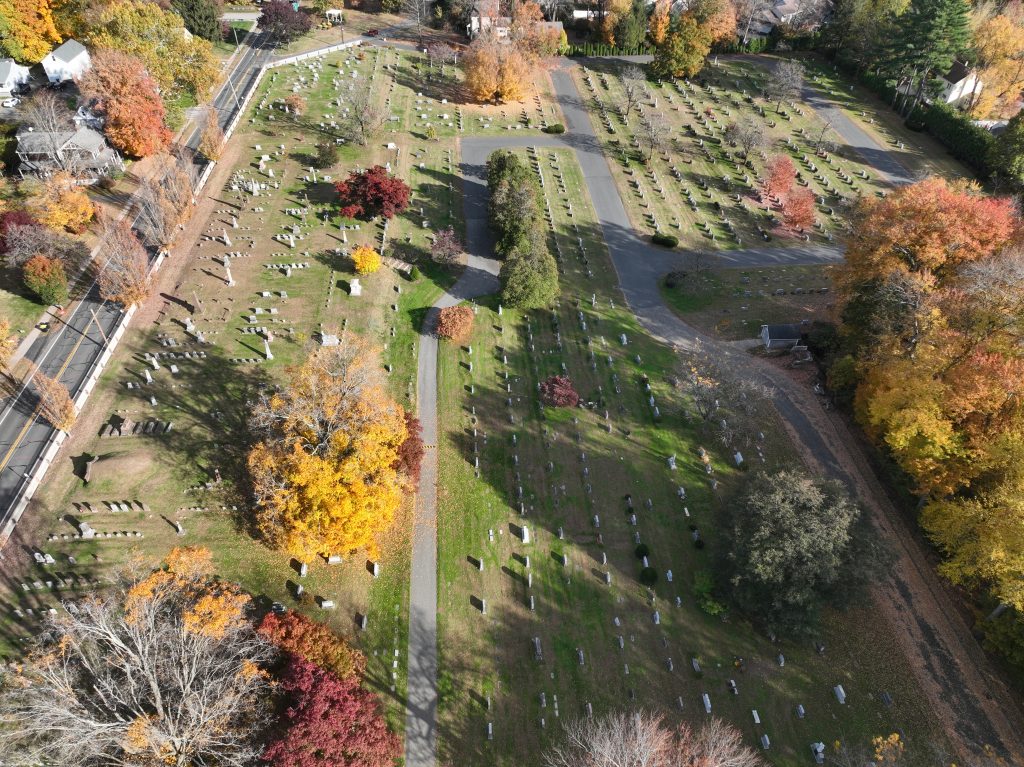
The Longmeadow Cemetery is located on Williams Street in Longmeadow, Massachusetts directly across the street from the Town Hall and Police Station and behind the First Church of Christ. The main entrance is off Parkside Drive.
Longmeadow Burying ground was first laid out 1702/3 upon the south side of the highway. In January of 1718, a vote was taken to “fence and clear for a burying yard, ten rods in length and four rods in breadth (1 rod = 16.5 feet). Since its founding, multiple additional parcels have been added to the original one acre, now measuring almost 8 acres.
The Old Burying Ground was included with the Longmeadow Historic District that was created in 1973.
The cemetery is owned and maintained by the Longmeadow Cemetery Association– a not-for-profit organization which was formed in 1872 (it is not affiliated with the First Church of Christ or the Town of Longmeadow).
The Longmeadow Cemetery is still an active cemetery
The Gravestones
Symbolism: death’s head, cherub [soul effigy], willow& urn, rooster [that crows at judgment day], hourglass, cut flower, [death’s] scythe, [death’s] dart
Stone shapes: tables, obelisks, tablets
Carvers: We have many carvers represented: Griswold, Bartlett, Stancliff, Johnson, Holland, Burt, Stebbins, Ely, Newell, Lathrop, Taylor shops.
Old terms seen on stones: relict (widow), consort (wife)
Oldest person buried (that we know of!): 106
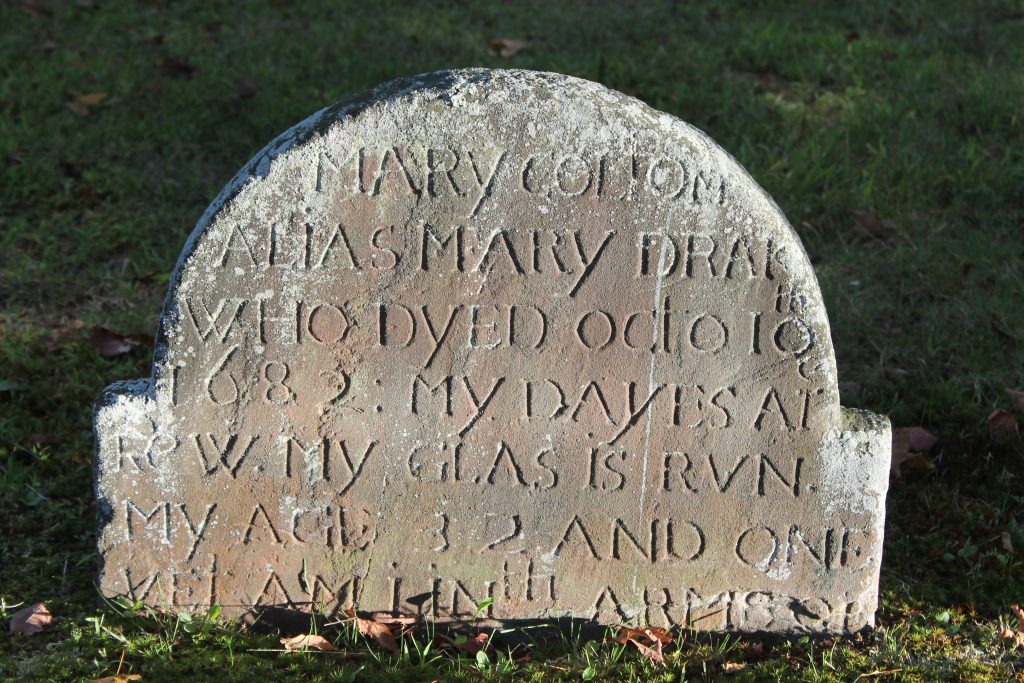
Earliest stone: Mary Drake “alias Colton” 1682 (Mary married Ephraim Colton Nov. 17, 1670)
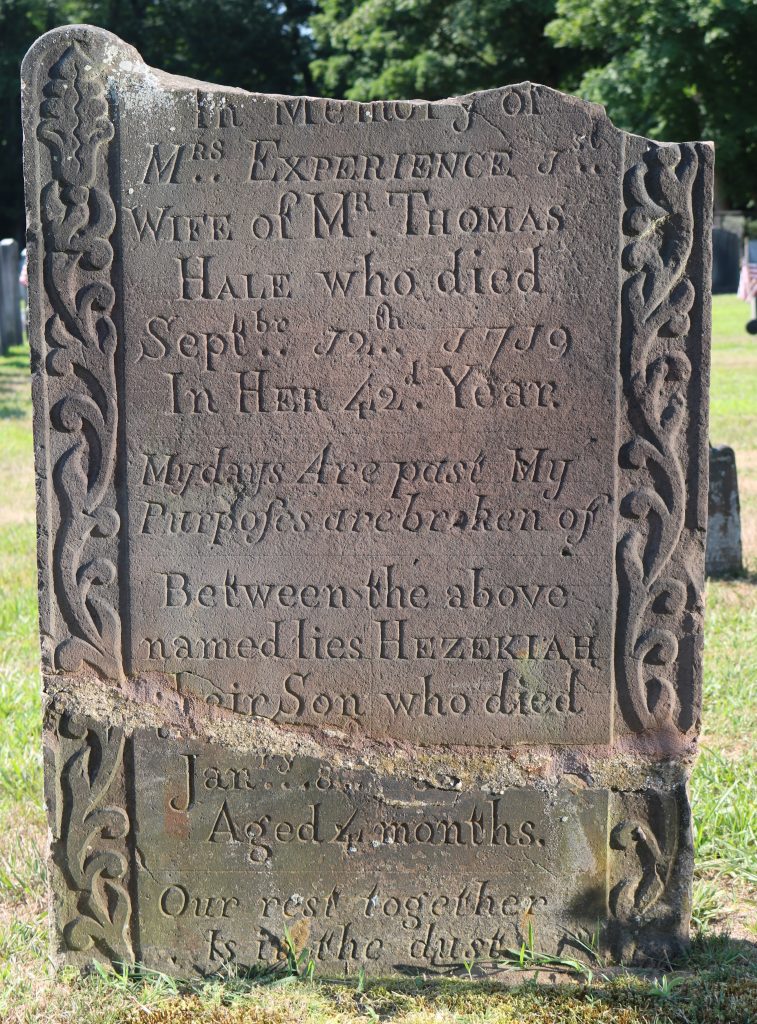
First burial in Longmeadow [for which there is currently a marker]: Experience Hale, 1719. Prior to the 1st or second decade of the 18th C, residents who died in the precinct of Longmeadow were buried in the burying ground in Springfield.
Stone material: Longmeadow sandstone comes from quarries in what is now East Longmeadow. We also have gravestones made of redstone from Middletown/Portland area Connecticut, Mount Tom area sandstone, marble (from the Berkshires), and granite. Longmeadow’s sandstone, originally laid down in the Triassic period, comes from a rock bed that is about 2000m or 6561 ft thick.
First cemetery was in Springfield–moved in 1848 when railroad went through. Some stones/bodies moved to other cemeteries, including here. Springfield’s old stones and any remains were relocated to Maple Street Cemetery, opened in 1841.
Causes of death [on the stone]: Gaius Bliss gored by a bull; George Colton died of smallpox; Lewis Stebbins died after small pox inoculation; Solomon Burt from powder mill explosion [May 7th, 1777]; Jerusha Colton, cancer; Edward Crandall drowned [while bathing in the Connecticut]; Nathaniel Burt slain at the battle [near Lake George, Sept 8th 1755].
Gravestones always sold as a pair–headstone and footstone until the 1850s or 60s. Few footstones remain. Bodies in most New England cemeteries were originally buried feet to the east [head stone facing west], so they would rise up & face the rising sun on judgment day. Some burying grounds – including – the oldest section in Longmeadow faced the main road. Based on records from the townsperson burying the dead in Longmeadow in the early 19th C we can estimate that about 40% of all persons buried do not currently have a marker.
Double dates on old stones: Julian/Gregorian calendars and New Years day. From 1155 to 1751 the English year began on 25 March. In 1752 it was moved back to 1 January. In England and Wales, the legal year 1751 was a short year of 282 days, running from 25 March to 31 December. 1752 began on 1 January. To align the calendar in use in England to that on the continent, the Gregorian calendar was adopted, and the calendar was advanced by 11 days: Wednesday 2 September 1752 was followed by Thursday 14 September 1752. The year 1752 was thus a short year (355 days) as well. Scotland had already partly made the change: its calendar year had begun on 1 January since 1600.
Who is Buried in the Longmeadow Cemetery
Veterans: of many conflicts: French and Indian wars, revolutionary, war of 1812, Civil War, Spanish-American, WWI, WWII (including Congressional Medal of Honor recipient, Edward Wilkin), Korean, Vietnam, Gulf Wars.
Do we have Native American or graves of enslaved? Probably, but we do not know of any specific markers. Ground penetrating radar (GPR) demonstrates probable burials above which there are not currently any markers.
People of any religious affiliation can be buried in the Longmeadow Cemetery
Longmeadow Cemetery Association Members
Officers
| President | Betsy McKee |
| Vice-President | Alfred McKee |
| Secretary | Ann S. Cordis |
| Treasurer | Jennifer Catanzaro |
| Asst. Treasurer | David Culver |
| Superintendent | Robert Danio |
Board Members
| Daniel Sheehy | David Culver | Betsy McKee |
| Jennifer Catanzaro | Alan Harwood | Michael Smith |
| Jean E. Clark | David Marinelli | Bruce T. Underwood |
| Ann S. Cordis | Alfred McKee | Yedalis Ruiz |
| John O’Rouke |
